

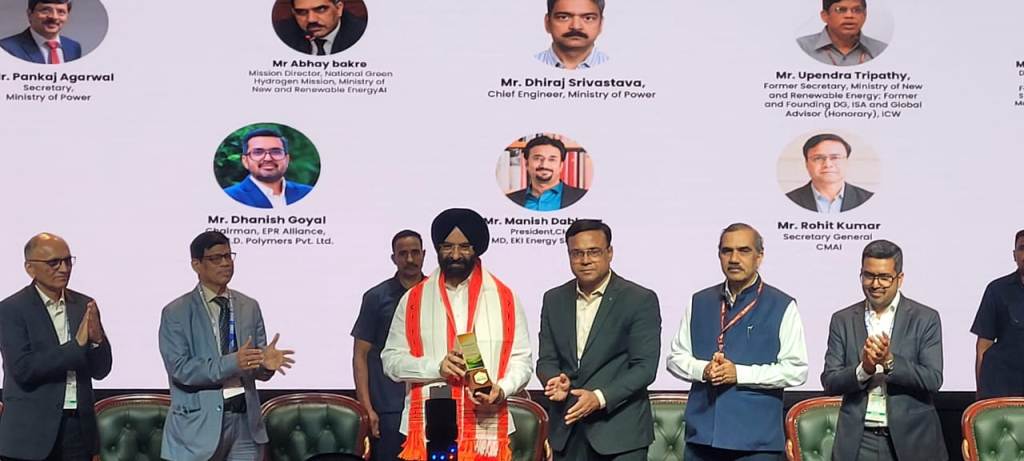
Announced during CMAI India Climate Week 2026” Summit at Bharat Mandapam, New Delhi
The Carbon Markets Association of India (CMAI) today inaugurated its flagship climate summit themed “India Climate Week 2026-Gateway to Net Zero” at Bharat Mandapam, New Delhi, bringing together policymakers, global climate experts, industry leaders, and sustainability practitioners to deliberate on accelerating India’s transition toward a low-carbon future.
The two-day summit, being held on March 16–17, 2026, aims to foster dialogue around carbon markets, climate finance, global collaborations, and policy frameworks that can enable India and emerging economies to achieve their net-zero ambitions.
The inaugural session was graced by Shri Manjinder Singh Sirsa, Hon’ble Minister for Environment, Forest and Wildlife, Government of NCT of Delhi, who highlighted the Delhi government’s ongoing efforts to strengthen environmental governance and improve ecological sustainability in the national capital.
Addressing the gathering, Shri Manjinder Singh Sirsa emphasized that the government is taking significant and structured steps to tackle environmental challenges in Delhi through focused policies, innovative schemes, and active monitoring mechanisms. He noted that protecting the environment remains a key priority for the administration, with initiatives aimed at improving air quality, strengthening green infrastructure, and promoting sustainable practices across sectors and importance of carbon market.
Saurabh Diddi, Director, BEE announced the launch of Indian Carbon Markets Portal to be launched on March 21, 2026. He was speaking during a session on India Compliance Carbon Market, a special session during CMAI India Climate Week 2026.
Mr. Manish Dabkara, President, CMAI, and MD & CEO, EKI Energy Services Ltd., added “The global transition toward net zero cannot happen without strong carbon market ecosystems. India has immense potential to lead climate action through innovative market-based mechanisms, technology adoption, and international collaboration. The ‘Gateway to Net Zero’ summit serves as a vital platform to discuss actionable pathways for scaling climate finance, enabling carbon markets, and accelerating decarbonisation across sectors.”
Speaking on the occasion, Mr. Rohit Kumar, Secretary General, CMAI & SAF Association, said, “India stands at a critical juncture in its climate journey. Platforms like CMAI are essential in bringing together policymakers, industry stakeholders, and global institutions to shape credible carbon market mechanisms. Through this summit, we aim to build strong collaborations, create awareness around emerging carbon market frameworks, and help Indian industries align with the global transition toward net zero.”
The inaugural day featured a series of high-level sessions focusing on the evolving global climate architecture and the role of carbon markets in enabling large-scale mitigation.
One of the key sessions, “Global Collaborations to Drive Climate Action under the Paris Agreement,” emphasized the importance of international cooperation, technology transfer, and sustainable finance to accelerate climate mitigation efforts aligned with Nationally Determined Contributions (NDCs) and long-term net-zero goals.
Another important panel discussion on “Role of Article 6 in Net Zero Transition,” organized in partnership with the London School of Economics (LSE), explored how international carbon markets under Article 6 of the Paris Agreement can mobilize climate finance, enable cross-border cooperation, and support scalable mitigation projects. Experts highlighted the strategic opportunity for emerging economies like India to attract global climate investments while strengthening domestic decarbonisation pathways.
The event also hosted a special session on India’s Compliance Carbon Market, led by experts from the Bureau of Energy Efficiency (BEE). The session provided insights into the regulatory framework and implementation roadmap of the Indian Carbon Market, expected to become operational in the coming years. Industry participants were briefed on compliance requirements, monitoring and reporting frameworks, and sectorial participation under the evolving carbon market ecosystem.
Additionally, a panel discussion titled “Unlocking Climate Action through International Voluntary Carbon Markets” focused on the role of voluntary carbon markets (VCMs) in mobilising private climate finance. Experts discussed the importance of high-integrity standards, transparent methodologies, and credible monitoring mechanisms to scale investment across priority sectors including renewable energy, agriculture, forestry, waste management, and emerging climate technologies.
The discussions throughout the day reinforced the importance of credible carbon markets, policy alignment, private sector engagement, and international collaboration in supporting India’s long-term climate commitments and accelerating the transition to a low-carbon economy.
The summit will continue on March 17, 2026, with further deliberations involving global climate institutions, industry leaders, financial stakeholders, and policymakers to identify actionable pathways for scaling climate action and strengthening India’s position in the global carbon market landscape.